

From Digital Twins to AI-Augmented Trials: HACLab's Vision for the Future of Drug Development
A 2026 roundup: how AI, digital twins, and in silico methods are reshaping drug development and clinical trials — from Ashley Eadie and Ravi Parikh.
- Log in to post comments
How do we make drug development faster, more efficient, and more representative of the patients who will ultimately receive new therapies? In a series of recent perspective and review articles, HACLab’s Ashley L. Eadie and Ravi B. Parikh — with their collaborators — chart how artificial intelligence and computational modeling are beginning to answer that question, from the earliest stages of drug discovery through the design and conduct of clinical trials.
Together, these three papers argue that “in silico” approaches and AI are no longer speculative add-ons but emerging pillars of modern therapeutic development — while staying clear-eyed about the scientific, regulatory, and ethical guardrails still required.
1. The arrival of digital twins and in silico trials in drug development — Nature Medicine (2026)
With Holly Fernandez Lynch and Naomi Scheinerman, the authors examine how digital twins and fully in silico trials are moving from concept to practice — and what it will take, scientifically and from a policy standpoint, to use them responsibly. Read in Nature Medicine
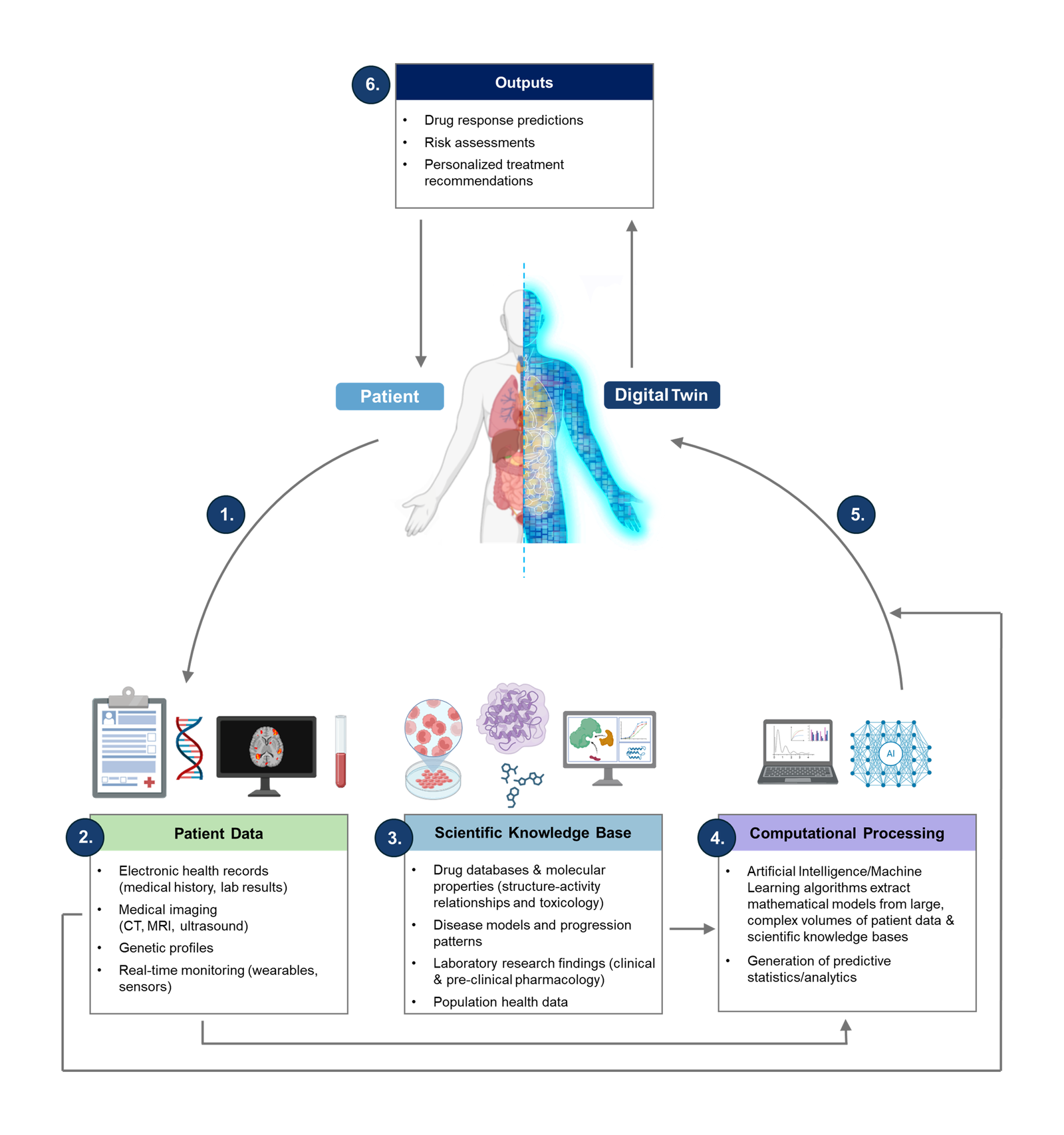
How a digital twin works: patient data and a scientific knowledge base feed computational models that generate drug-response predictions and personalized treatment recommendations. Figure from Eadie et al., Nature Medicine (2026).
2. Advancing FDA New Approach Methodologies from animal models through digital twins — npj Digital Medicine (2026)
This piece looks at the FDA’s push toward New Approach Methodologies (NAMs) — alternatives to traditional animal testing — and argues that digital twins can help bridge preclinical models and human-relevant evidence in how new therapies are evaluated. Read in npj Digital Medicine

New Approach Methodologies (NAMs) — in vitro models such as 2D/3D culture and organ-on-a-chip, and in silico models such as QSAR, PBPK, and QSP — build toward digital twins and in silico trials as alternatives to animal models. Figure from Eadie et al., npj Digital Medicine (2026).
3. AI-based augmentation of oncology clinical trials — Nature Reviews Clinical Oncology (2026)
Oncology trials are often slowed by low accrual, high failure rates, and limited generalizability. This review maps how AI — powered by large-scale EHR data and machine learning — can strengthen every stage of the trial lifecycle, from design and patient identification to post-trial inference, while confronting equity, data-quality, transparency, and regulatory challenges. Read in Nature Reviews Clinical Oncology

AI across the clinical trial lifecycle: applications spanning pre-trial design, within-trial operations, and post-trial inference and generalization. Figure from Villa A, Eadie AL, … Parikh RB, “AI-based augmentation of oncology clinical trials,” Nature Reviews Clinical Oncology (2026).
A common thread. Across all three, the message is consistent: AI and computational modeling can meaningfully accelerate and improve therapeutic development — but only when paired with rigorous validation, thoughtful regulation, and a commitment to equity. It’s a vision of drug development that is not just faster, but fairer and more evidence-driven.
Explore more of our work across the HACLab site, or reach out at haclab@emory.edu.
